
Interview with Islam Ezzat
Participant in the 2025 MT180 International Final
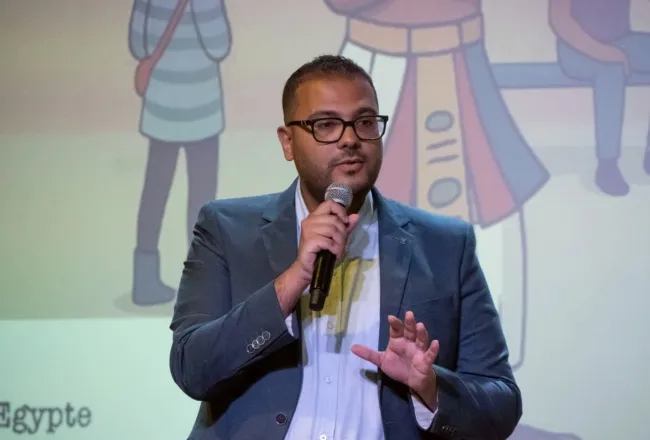
On Thursday, October 2, 2025, Islam Ezzat represented Egypt at the 11th International Final of the “Ma Thèse en 180 Secondes” (MT180) competition. The PhD student is pursuing his thesis under a joint supervision agreement at CY Cergy Paris University
Published on
Reading time : 3 minutes.
Islam splits his PhD project between Ain Shams University in Cairo and the ERRMECe laboratory at CY Cergy Paris University, under the supervision of Patrick Di Martino, a university professor in microbiology. Islam’s research focuses on heritage, museology, and the conservation of archaeological objects. He won the Egyptian national final last June after intensive preparation and impressed the jury with his presentation on the microbial biodiversity of ancient wood and associated eco-friendly treatments. He then represented Ain Shams University at the international final, which this year was held in Bucharest, Romania, competing against 19 other French-speaking candidates from around the world. On this occasion, we asked him a few questions.
CY Cergy Paris University: Could you briefly present your research topic?
Islam Ezzat: My PhD project is entitled "Microbial Biodiversity of Ancient Egyptian Wooden Collections: Towards Green Preventive Methods." In simple terms, I work on the preservation of Egyptian archaeological heritage, focusing specifically on wooden objects displayed or stored in museums. These objects are threatened by microorganisms such as molds that degrade them. My objective is twofold:
- Understand: Precisely identify the microbial biodiversity responsible for the degradation.
- Act: Develop "green" conservation treatments that are safe for the objects and the environment, as alternatives to often-toxic chemical biocides.
In essence, my work aims to reconcile the safeguarding of our cultural heritage with an ecological and sustainable approach.
CY Cergy Paris University: What motivated you to participate in MT180?
Islam Ezzat: Several reasons motivated my participation. First, MT180 is an exceptional exercise in science communication. It taught me to talk about my research clearly and passionately, beyond the technical language reserved for specialists. Second, it was a unique opportunity to highlight a subject at the crossroads of multiple disciplines: microbiology, heritage material science, and Egyptology. Participating in this competition was a way to demonstrate that fundamental research can have concrete applications for the preservation of our global cultural heritage. Finally, as a PhD student pursuing a joint degree between France and Egypt, it was an opportunity to represent the richness and dynamism of international scientific cooperation.
CY Cergy Paris University: What did you gain from your participation?
Islam Ezzat: Participating was an extremely enriching experience on several levels. Personally, it was a tremendous confidence booster, both in myself and in my work. Presenting my research to a large audience and a prestigious jury demonstrates rigor and mastery. Professionally, it provided valuable visibility within the scientific community and among heritage conservation stakeholders. I was able to interact with researchers from other fields, opening doors to future collaborations. In terms of skills, the exercise taught me to condense years of complex work into a compelling three-minute message. This ability to communicate effectively is invaluable, whether for securing funding, teaching, or sharing scientific results with the general public.
CY Cergy Paris University: How does your joint PhD work in practice? How is your collaboration with CY Cergy Paris University?
Islam Ezzat: The joint supervision setup is a wonderful opportunity that structures my PhD very concretely. In practice, I split my research time between the two countries according to a schedule defined in an agreement signed by CY Cergy Paris University and Ain Shams University. I have four thesis supervisors who guide and oversee my work. This dual expertise is incredibly enriching: I benefit from microbiology and eco-design expertise at the ERRMECe laboratory, and from specific knowledge in Egyptian archaeology and conservation at the Laboratory for Research on Historical Monuments (LRMH) and at Ain Shams. I also apply my knowledge in prestigious museums in France and Egypt, such as the Louvre in Paris, the Rodin Museum, and the Egyptian Museum in Cairo.
My collaboration with CY Cergy Paris University is excellent. The ERRMECe team is very welcoming and provides a stimulating research environment, with access to state-of-the-art technological platforms. Campus life is dynamic, and the university offers strong support to international PhD students. This immersion in two different research systems is a true asset: it allows me to test my ideas, adopt complementary approaches, and build an international professional network, which will be a major advantage for my future career.